Showing posts with label poetry. Show all posts

Saturday, 20 August 2022

Swimming in the Dark

The flock flew up - We saw them then:
Thousand stars every direction.
We were below - Out in the dark.
Ancient rises beyond the beach
Appeared to move in time with each 
[wave].
Even at distance they were cold.
Bright lights swam up from the seabed 
And we both were carried away.
This quiet - Beneath endless sky.
We floated there
And talked.

Wednesday, 15 June 2022

written for a tweet on a sunny day

you've put on sunshine again

and look your best 

clear halo in bright tops

light in rises catching drops

cooked clean, round here's in a fetching vest

hedge resplendent still

over chirp under trill

this horse manure ditch street 

has us loosing unbound feet

Saturday, 28 August 2021

notes for a sentimental poem

walking home under the stars

listening to music from another continent

electric magic I might never comprehend

lyrics in a language I don't know

sung in a voice that makes me want to cry out loud

but the dark road and the endless way

[in leaves underfoot and speckled worlds overhead]

makes silence perfectly preferable 


electric magic I'll never comprehend

flashing roadworks signs

and stillness my only friend

Tuesday, 6 July 2021

274

 you slip below the pavement

the slats of wood an inch apart sometime

and when Wednesday comes that song with

echoes

plays through from 

your one ear and out your hair again

you are

spreading fingers to take in the peace

when weather takes you up in its indifferent embrace

it's warm enough to lay out 

and cool enough to stay wet after 

freezing swim

you slip below the surface

down where it's quiet for a mile on every side

so you swim on to below the pavement

light is split by the boards above

it hurts to look up anyway 

blind steps take you by the eyes

you find yourself picking yourself up from your floor

ten minutes lost

gravel rash to the face

and that reverb pacing out the distance 

from your inner ear to your domed dementia

starlings have set a nest there

and you climb down while ascending

stretch and accept this rippling call

cross the new waters

where you dived in

Thursday, 31 December 2020

twenty-one new years resolutions

I will plan to be better in the future tense
As of midnight all self-improvements recommence
I would step over buildings without breaking stride
Be yogafied daily till it engenders pride
Run in the rain, up hills and along the beaches 
Sing loudly just to see where to my voice reaches
Give up coffee again and leave my comfort zone
Stop spending half the day just staring at my phone
Disentangle the nervousness within my dog
And learn to live with my internal monologue
Give loads to charity without telling a soul
Stand up to butter: exercise self-control
Go rock climbing and swimming till my toes give out
Hit the brakes: do a U-turn on the road to gout
Read more and go out more and learn an instrument
See the ordinary can be magnificent
Learn to keep schtum while also having my say
Ease off and
take each day
as just 
another
day

Saturday, 5 December 2020

Emma Lazarus: Petrarchan Sonnet - The New Colossus

This post is about the poem The New Colossus by Emma Lazarus. The poem is most famous for appearing on the pedestal on which the Statue of Liberty sits. From that pedestal inscription, people often quote the following lines: 

'Give me your tired, your poor,  
Your huddled masses yearning to breathe free'

Emma Lazarus

Emma Lazarus (1849 -187) was an author, poet and translator (Italian to English). She also campaigned for better educational and employment rights for Jewish people, especially Russian Jews who had gone to America after fleeing pogroms.

She wrote The New Colossus, for which she is best known, in 1883. She donated the poem to an auction that was held in order to raise funds for the pedestal on which the Statue of Liberty was to stand.

The statue, or rather the lady it represents, is the subject of the poem and the persona that declares those famous and noble lines: '"Give me your tired, your poor, Your huddled masses yearning to breathe free"' (more of that later).

Lazarus wrote the poem in the style of a Petrarchan sonnet, a form that inspired numerous writers in the renaissance and beyond and one that harkens back to the 14th century Italian humanist Francesco Petrarca. Petrarca didn't devise the form himself exactly but it is named after him. He did write some 366 love sonnets, so he probably deserves acclaim.

A Petrarchan sonnet consists of 14 lines. These can be neatly divided into a set of 8, followed by a set of 6. The initial 8 lines, or octave, sets out the conflict or topic raised by the poem. The final 6 lines, or setset, resolves the conflict or provides a commentary on the topic.

In the case of Lazarus' poem, The New Colossus, the octave describes the character of the Statue of Liberty. The setset then gives voice to her welcoming declarations. 

The colossus of the title, which is explicitly referred to in the first two lines, alludes to one of the seven wonders of the ancient world: The Colossus of Rhodes, which depicted the Greek sun god Helios. 

A depiction of the Colossus of Rhodes, clearly extremely true to life. The original was apparently two-thirds of the height of the Statue of Liberty.

Lazarus' statue, or Mother of Exiles, is set in contrast to the sculpture of Helios. Whereas the sun god is represented as standing in Rhodes with 'conquering limbs astride from land to land' [across the harbour], the American figure, said to be Libertas, is a 'mighty woman with a torch', who offers 'world-wide welcome'.

Personally I'm particularly fond of the following lines: 'her mild eyes command/The air-bridged harbor that twin cities frame.'. The twin cities are New York and Brooklyn, unincorporated then, whereas the air-bridges have nothing to do with post-Covid travel arrangements and everything to do with the architecture within New York Harbour.

When the statue was designed, by French sculptor Frédéric Auguste Bartholdi, it was intended to represent a goddess of liberty. The final 6 lines/setset of the poem do, however, solidify Lazarus' declaration of the statue's meaning for immigrants.

She refers to the poor and hungry and those 'yearning to breathe free' [especially poignant in light of her concern about Jewish persecution in Europe], and in the persona of the statue, Lazarus says: 'Send these, the homeless, tempest-tost to me'.

The poem has been interpreted in diverse ways over the intervening near century and a half since it was written. To me it spells out an ideal and beautiful sentiment: refugees should be welcome and liberty should reign. That is enough interpolation from me, though: instead, here's the full text of the poem:

Not like the brazen giant of Greek fame,
With conquering limbs astride from land to land;
Here at our sea-washed, sunset gates shall stand
A mighty woman with a torch, whose flame
Is the imprisoned lightning, and her name
Mother of Exiles. From her beacon-hand
Glows world-wide welcome; her mild eyes command
The air-bridged harbor that twin cities frame.
“Keep, ancient lands, your storied pomp!” cries she
With silent lips. “Give me your tired, your poor,
Your huddled masses yearning to breathe free,
The wretched refuse of your teeming shore.
Send these, the homeless, tempest-tost to me,
I lift my lamp beside the golden door!”

Friday, 4 December 2020

be calm and stay strong

be calm and stay strong

you won't find a solution while you're ranting and raving

stay calm and be strong

you won't be able to get what you want while you are losing the plot

and strong stay be calm

you will lose everything you care about if you are constantly hitting the roof

strong and calm be stay

you will watch your dreams disappear away from you because you were too preoccupied with hatred

calm be strong and stay

you will lose what is most important because you were distracted by anger

Monday, 12 October 2020

birds in the spanne

there are birds in the greenhouse - lots
there are flying insects too 
and every square millimetre of earth contains countless microbial beings
it is a rich place and safe
hot airy
the lights crane open
the clouds pass
the birds loose from end to end
the whole spanne: 
lemon flowers, figs and unceasing wings

Wednesday, 13 February 2019

You, Me and Nina Simone

when Nina Simone climbed in the window
you said it was a simple present though
we both knew you'd gone to great lengths to get
us a visit from this star, better yet:
one now immortalised as a robot
more, considering the talent she's got
and the fact that she is living tissue
over a metal endoskeleton
sent back from the future to entertain
somehow though it seems a tad inhumane,
android or not, for this living legend
to be forever, throughout time, destined
to provide this sing-a-gram service
besides, meeting idols makes you nervous
so the three of us sat down together
chatted about this and that: the weather,
relaxing with the high priestess of soul
since it was mild later we all took a stroll
and sang together too: I have to say
there could be no better Valentine's Day

Tuesday, 12 February 2019

Métivier Limerick (1)

Because of the joy what his poems gave
I went to find George Métivier's grave
He was bearded and gruff
I'm a hairless cream puff
Out of respect I went without a shave


The grave is only a few hundred metres away from our house in St Martin's. I still can't find it exactly. Normally I have the dog with me when I'm passing there. He prefers to keep moving and I follow his lead.

Saturday, 12 January 2019

Manchester - Sheffield 10/01/19

we are somewhere high on the pass
streaming lights like a sea of grass
more real and dull than I reckoned
you're worse removed every second
pray with feeling: forever hunt
once home we'll become what we want

Sunday, 16 December 2018

magic 9: 2nd attempt

I've been reading about the poetic form 'magic 9', which uses an abacadaba rhyme scheme. Here's my first attempt at writing a magic 9 poem. Different parameters this time -  7 syllables per line, as opposed to alternating between 5- and 7-syllable lines.

Here's my second attempt:

in winter: darkness's height
we get a family feast
and since we know it ain't right
when all is meant to be fine
just to scream and fuss and fight
'stead let's make a cosy scene
where the fire's glowing bright
we are together at least
with games: what a lovely night

Sunday, 9 December 2018

magic 9: 1st attempt

Recently I've been reading about the poetic form 'magic 9'. It uses an abacadaba rhyme scheme. I don't think the metre is restricted, so I've chosen to alternate between 5-syllable and 7-syllable lines. Interested to get feedback on that choice. Below is my 1st, quick attempt at writing in this form.


cosy evening in
while wind howls all round outside
sing with kith and kin
games together in the warm
no matter: lose/win
we discuss weather always
laughing at rain, Lynn!
watch the fire burn: it's Yuletide
wine, whiskey or gin?

Friday, 30 November 2018

I think you are the ocean

I think you are the ocean
the depths sound the saddest song
a vein of emptiness splits the foundations in me
where the sun touches the peaks and sides of your every wave
a life rises up, dolphins in your wake
a murmuring choir of cormorants and such
darts thick as a single thread,
thin as breath across the entire seabed
your slow-moving eyes pass over a sunken kingdom
presiding Poseidon, you are the ocean

Wednesday, 28 November 2018

there are ghosts on the road

out in the Pingtung country
there are ghosts on the road
happens when you stop softly
the one sound's a single toad
making a single croak
in fifty-mile wide silence

this half-hour bike ride's on rails
stillness has become concrete
chill now after daylong heat
dogwood sports heads, roots for tails

and within this farmyard land
only odd streetlights at hand
stop near a tiny temple
hear music drifting gentle

cycling in silence alone
these are the things you are shown
plain as the river has flowed
there are ghosts on the road


I lived briefly in Pingtung. I used to ride my bike around a lot, including after dark. There was definitely something magical, and occasionally eerie, about the countryside there.

Tuesday, 13 March 2018

Falling Asleep to Puppet Theatre

I wrote a poem about 5 years ago when I was staying at a guesthouse in Taidong in Taiwan - it was about falling asleep in front of the telly, on which there was a programme of Taiwanese puppet theatre playing. I've just been reading about, and watching videos of, the brilliant Murray Lachlan Young. The following poem is my 5-minute attempt to rewrite that old poem, while emulating Young's rhymes:

and when you slump down in your chair
vision starts to go: eyes dropping, drooping
whether it's bedtime or not, you do not care
your thoughts wander to ancient gods swooping
as your dreams gather your mind's eye sets
to lightning scooping

and though really it's just the telly noise
from where you're sat it's become really real
so that on-screen battles of toys fighting toys
become burning exchanges: every blast you feel
as one mystic being kills another again you think 
you yourself have been run through with steel

then you wake up and realise where you are
it's just a front room with a fan going and a TV on 
someone outside's just pulled up in a car
all that fear and apprehension might well be gone
but still on the goggle box
a wild witch floats past, graceful as a swan

what's puppet theatre anyway, when storms gather outside
watching children's programmes in a foreign land
I really do need a guide

Friday, 9 March 2018

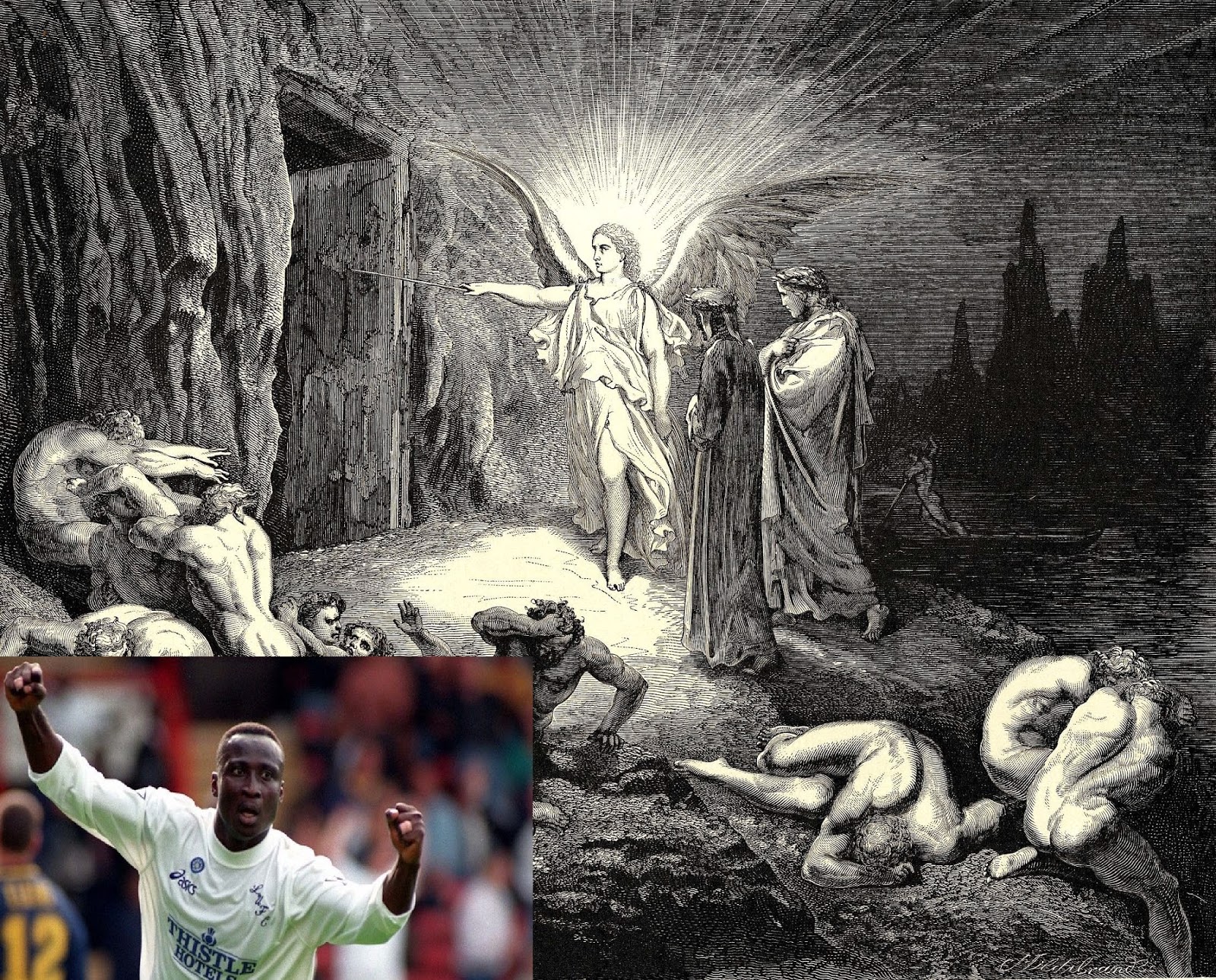
draft: Yeboah Inferno Mash-up

draft of a proposed Tony Yeboah Dante mash-up - feedback needed, of course
illustrations by Gustave Doré, with a few changes, included for fun


midway through the journey of my childhood
I found myself at an intersection
between stages of youth

teenage angst lay ahead
all around were savage
the very thought of it renews the fear

I can't say how I wound up lost
so full I was of slumber
hearing only Oasis and Greenday

I had abandoned the true way
left those hours of watching Leeds
highlights back in the day

once I met that guide
glorious rays spoked out round
terror ceased


beforehand I'd been a shipwrecked sailor
watching waves reaching a desolate shore
no living soul to know

now rested and calmer at least
it seemed I was alone no more
gone suddenly from famine to feast

I beheld him in that vast desert
"have pity on me" I cried
"whether you're undead or just alive"

to show he lived still
he scored
in off the crossbar

said "I've transferred from Germany
to show you the way"
well, I've loved football from then till this day


Wednesday, 7 March 2018

5-minute Poem: Schlachtensee

Schlachtensee

shh-lack-ten-zee/sch-lach-ten-see/ˈʃˈlækˈtɛnˈziː

there were peaceful moments there when you felt the whole city had melted away - sun shining constant - and the trip had made it all the better - travelling by train makes the pace rattle and soothe -
"your head has time to adjust to the new location"
- and this, a place only a few miles outside of the capital city of one of the industrial powerhouses of the world, whether or not the industry is decayed block techno squats
- and this a place where the midges stand in a halo, the nonstop sun is reflected and refracted through pines and that water
- you sink into sediment -
space is granted to you alone, even as you pass other bathers,
even as you know you'll return to the sausage and chips/the bar benches and beer
even though the train station waits at the end of the swim-reading-nude day
ach du scheiße: Guernsey discovers nudism in Germany
- on this point a moment, forgive me: a statuesque woman, who looks like she's hiked halfway across the country, small dog in tow, stops just short of the path and strips off completely before plunging into the cold water - is this why I remember Schlachtensee?

Tuesday, 6 March 2018

Accidental Nonsense Poetry

having my phone in my pocket means that I'm often in trouble 
it's developed a habit of ringing people, without me asking it to do so,
and messaging folk that I haven't seen or heard from in years
(a receipient of one such message simply messaged back "??" - 
had he not done so I wouldn't have known that my 
hyperactive phone had been sending him utter gibberish)

then today I opened up Google Drive,
only to find that a new document was sitting proud at the top of the 'recent' pile.  
it's a rewriting of an old poem of mine, Went Running in the Rain. 
I think this version might have improved on the original. 
it seems more creative and it's not a great deal more difficult to follow
(also, unlike the original, it mentions both Ed Milliband and a 'turncoat'):


  + ?090 flew
In short-lived but no less blissful forgetfulness
Then, crrdddgc3:-3)1)&”?:$wrongf_!2?
@@@1/2oming stitch-stricken round the final turncoat ovgoio ou
I could smell so many rain-freed scents listing ed Miliband to the gym now I'm
As barbeques &did burn
And other summer smells rose on the air
The earth reeked of fertility
The grass gave up some living spirit
And I had to walk for the last bit

Wednesday, 25 October 2017

Learn a Poem Challenge - The Lamentations of Damaris by George Métivier


The challenge has gone round at work – 'learn summat! It’s good for you!' (This challenge being part of a campaign to make us fitter, healthier, wiser and more mindful). 

Well, all right then. I will learn something. I’ll even pick something from the list of suggestions. Let’s consider these: “learn how to cook something new”. Daily I slave avail-lessly in an experimental fashion with vegetables and pots and pans trying to make something that approximates to edible matter. I reckon I’ve got that one covered. For the time being. Thank you. Berry much. 

Next: “learn how to fix something” – this I can do. I will do. This I need to do, in fact. 

Come to think of it, I really better get on and fix that bike of mine. With wet weather being so much more common now that winter’s properly in the post winging its way here-wards, the brakes I’ve been meaning to sort properly for a while, well, those are now deadly. And today, out of the blue, the blooming cable for my blinking rear derailleur on my goodness-knows-wonderful bike went and popped off with a pop sound like a pair of trousers splitting on my oversized behind.

I’ll fix that. But I want to learn something else. “learn a poem” says the Health Promotion Unit poster. Perfect! Here goes.

I will memorise and recite part of a Métivier poem (George Métivier: the author of the first Guernsey dictionary, wrote in the local language). I've chosen The Lamnetations of Damaris, which, despite being very specific to the 1820s in this Norman isle, feels timeless for me, as a Guernseyman, especially with its mention of somebody angry at the States knocking something down. Come on. The protagonist/persona of Métivier's poem "bitterly blameth the States" (chés tout-en-travers d'Etats!). It could be set in 2020 for all we know.

Please forgive my reading. Mea culpa, as always. The text, I'll post below. Video pending. Bisous.


Lamentations of Damaris

Old Fountain Street's all in a flutter,
Its dwellers are all in a stew,
There is growling from garret to gutter,
That the old must give place to the new!
Damaris harangueth her neighbours,
And bitterly blameth the States,
For enacting such wide demolition
Like aught but beneficent Fates!

Quoth the Dame: "I have lived in my rat-hole,
In quiet, for sixty odd years!
My blessed, old dirty, old attic,
The hearth of my hopes and my fears!
But the poor must submit to the wealthy,
The humble bow down to the grand;
We had better be laid 'neath the daisies,
In the churchyard of Mister Durand!
"It is said that pride preludes destruction,
But we are annoyed all the same;
Yes, Sirs, you may sulk or look smiling,
But I'll say what I think of your game!
To treat an old creature like me, so,
And pull down my crib as it stands,
Whence one can from the third-story window,
With one's opposite neighbour shake hands!

"My father and mother have dwelt there,
Have eaten their soup and their bit,
Have gathered their bairnies about them,
In that blessed old niche where I sit,
Aunt Ann spent her evenings with glee there,
And there, as young bairns, we were nursed,
Yet you harshly drive out the old woman,
Would it were in a coffin, feet first!"


(translation taken from J. Linwood Pitts’ anthology The Patois Poems of the Channel Islands, 1883)


If you'd like more background on the poem, I'd recommend the Priaulx Library's excellent page on it. Additionally, they have this page here on Fountain Street as it existed in 1763. Clearly, Métivier's not the only one to say that the top story windows in opposite buildings on 'old Fountain Street' came so close that residents were able to shake hands from building to building. Seems like those States Works boys were doing the right thing when they brought those homes down to widen the way. Still, Damaris lost her home, so I can see it from her point of view. (enough rambling).

Before reading this poem I didn't know that Damaris is a figure from the Bible, one of Paul's letters to be precise. She was present at one of Paulie's speeches, it says in Acts.

By the way, the text of the poem I have included above is abridged. My video of the poem, which I'm trying and failing (at the moment) to upload here, features an even more abridged version.

from Patois Poems of the Channel Islands


Georgie Boy himself